Why Free Trial Users Don't Convert — and How Win-Back Offers Rescue Them
You start a free trial on a Tuesday night, poke around for six minutes, and cancel on Wednesday morning — not because the app was bad, but because you’ve been burned before. Cancel now, avoid the surprise charge, keep the access until the trial expires anyway. You tell yourself you’ll “really test it this week.” You don’t. The trial quietly ends, and an app that might genuinely have solved your problem joins the graveyard of things you almost tried.
If you build software, the same scene looks different from the other side: a user who signed up, showed real intent, and disappeared without ever seeing the thing your product does best. Here’s the uncomfortable truth we’ve learned building BeeDone: most trial users don’t convert because of friction, unclear value, and bad timing — almost never because they carefully evaluated the product and rejected it. And a cancelled trial isn’t the end of the story. It’s a signal — one you can only act on if your funnel is observable and your rescue offer is consistent. This article covers the psychology of why trials die, what actually moves trial conversion, and what we had to fix in our own win-back flow to make any of it true.
The Psychology of an Unconverted Trial
Five well-studied effects explain most trial abandonment. None of them are about price.
Friction compounds. Every extra tap, form field, and “Next” button is a small tax on motivation. Behavioral scientists describe this as the path of least resistance: even people who want the outcome drop out when the path to it costs more effort than their current motivation covers. In onboarding, the first two minutes carry most of the risk — a user who hasn’t yet experienced value has almost no reserve to spend on your setup screens.
Choice overload paralyzes. The famous jam-shelf experiment by Iyengar and Lepper found that shoppers offered 24 jams were far less likely to buy than shoppers offered 6. A trial that opens onto fifteen features, three tabs, and a settings page triggers the same freeze. The user doesn’t pick the wrong feature — they pick nothing, close the app, and “decide later,” which is how most trials actually end.
Intentions without a plan evaporate. Peter Gollwitzer’s research on implementation intentions shows that “I’ll test this app properly this week” almost never survives contact with a real week, while “after my Thursday stand-up, I’ll plan Friday in the app” often does. Trials die in the gap between vague intention and a concrete when-then plan — which is why a well-timed reminder mid-trial can matter more than any feature.
Loss aversion cuts both ways. Kahneman and Tversky showed that losses loom roughly twice as large as equivalent gains. Before a user has invested anything, the looming loss is the subscription charge — which is why so many people cancel on day one as self-protection. But once a user has a streak, a level, a week of completed tasks, the asymmetry flips: now walking away means losing something. A trial that builds nothing worth losing has no gravity at the end.
Habits need a loop, not a feature list. A cue triggers a routine, the routine earns a reward, and repetition wires it in. A trial converts when the app has entered at least one real loop in the user’s day. We’ve written before about why you check your streaks more than your tasks — that pull is exactly the mechanism a trial needs to create, on the work itself, before day fourteen.
What Actually Improves Trial Conversion
The psychology above translates into a short, practical list. This is what we watch — and build against — at BeeDone.
Remove taps you can remove. The single cheapest win is deleting steps. In BeeDone’s onboarding questionnaire, choice steps used to require a selection and then a tap on “Next.” We recently made them auto-advance the moment you select an answer — one less tap on every step of the most expensive stretch of the funnel. It sounds trivial. Multiplied across every new user and every step, it isn’t: friction removed at the top of a funnel pays rent forever.
Get to a real “first win” before asking for anything. The user should complete one genuine unit of value — a task done, a day planned, a focus session finished — before they hit a paywall or a configuration screen. If your product’s core loop takes days to demonstrate, engineer a small version of it that takes minutes. Organizing and planning feel productive but aren’t the win — the first completed thing is.
Give the trial a mid-point pulse. A fourteen-day trial has a dead zone in the middle where intention quietly expires. BeeDone sends a day-5 reminder for exactly this reason: early enough that the trial can still be rescued by usage, late enough that the user has context. This is implementation-intention scaffolding — you’re converting “I’ll test it properly” into “open it now, here’s where you left off.”
Make the effort visible and losable. XP, levels, streaks — gamification makes habits stick not by decorating the app but by accumulating something the user doesn’t want to abandon. By the end of a good trial, loss aversion should be working for conversion, not against it.
Measure the funnel as one funnel. You cannot improve what you see in fragments. For a long time our analytics told us how often the paywall was shown with full context — which variant, which trigger, which onboarding moment — but the events that followed (subscribe pressed, cancelled, subscribed) fired without those dimensions. We could see the global abandonment rate and attribute it to nothing. We recently merged show → press → cancel → subscribed into one funnel, slicable by the same dimensions end to end. Within a day, questions that had been unanswerable for months (“does the hard paywall variant cancel more at onboarding?”) became one query.
Win-Back Offers Only Work When the Rescue Is Consistent
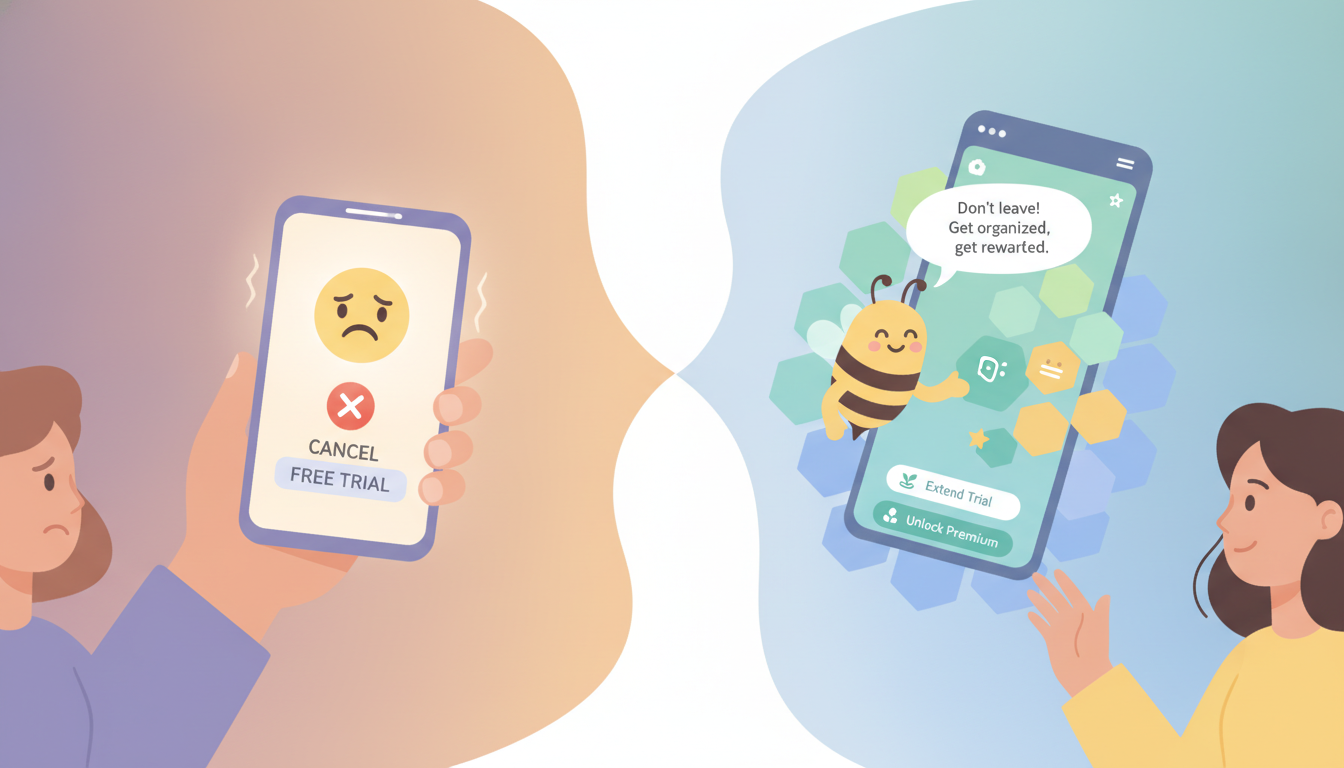
Here’s the part most articles skip, because it’s embarrassing to write. A win-back offer — the discounted rescue you extend to someone who cancelled their trial — is one of the highest-leverage tools in subscription software. It targets people who showed intent, at the exact moment their objection is freshest. And it is shockingly easy to build one that silently doesn’t work.
We know because ours didn’t. When we audited our trial-cancellation flow this month, we found that over a two-and-a-half-week window, nine users had cancelled their trials and received nothing — zero emails, zero offers, zero day-5 reminders. Not because the flow didn’t exist. It existed, looked finished, and failed quietly: a missing database index made the email job fail on every single run, with the error swallowed by a try/catch; the eligibility check rejected cancelled-trial users because cancelling a trial keeps your premium status until it expires, so the “don’t offer discounts to paying users” gate ate exactly the segment the offer was built for; and the day-5 reminder queried a 1-hour window on a job that runs twice a day — covering 2 hours out of 24, it ran 37 times and sent zero notifications while 16 trials started.
Then we found the second failure mode: inconsistency. The win-back email that would have gone out offered one price, while the in-app rescue offer showed another — the catalog behind the email was two generations behind the app. Imagine cancelling a trial, getting an $18 email, opening the app, and seeing the same offer at $60 an hour later. Nothing kills the credibility of a rescue faster than the rescue contradicting itself. We aligned the price to a single tier, made sure re-subscribing clears the win-back flag (so nobody keeps a lifetime discount for having once cancelled), and fixed the push notification so tapping it opens the actual offer instead of dropping you on the home screen to hunt for a badge.
The general lessons, if you’re building your own funnel:
- A win-back flow you don’t observe is a win-back flow that’s broken. Ours failed for weeks with green dashboards. Count deliveries, not deployments.
- The rescue must be one coherent thing. Same price, same product, same landing point — email, push, and paywall telling one story.
- Cancellation is your trigger, not your verdict. The user who cancels on day one out of loss aversion is often your most rescuable segment — they cared enough to protect themselves from the charge.
Where BeeDone Fits
BeeDone is a gamified productivity app: tasks, habits, and routines wrapped in XP, levels, streaks, and AI coaching, so that doing the work is what gets rewarded. Everything above is how we run our own trial — fewer taps in onboarding, a visible first win, a day-5 pulse, and a rescue offer that (now, verifiably) reaches the people it’s meant for.
It’s an honest fit if your bottleneck is starting and sticking: you know what to do, but tasks feel heavy, days leak away, and plain to-do lists die on you within a week. The trial is designed so that by the time it ends, you have a streak and a level you’d feel the loss of — which is loss aversion doing honest work. If task paralysis and decision fatigue are your daily reality, the mechanics were built with you in mind.
And it’s not the right fit for everyone. If you manage a team and need shared projects, assignees, and reporting, a dedicated team tool will serve you better. If game mechanics leave you cold — some brains simply don’t respond to XP, and that’s fine — a minimalist list app will outlast us on your phone. If what you need right now is emotional self-care rather than execution, a gentler companion app is the better choice. A trial exists so you can find this out for free; cancelling because the fit isn’t there is the system working, not failing.
FAQ
Why do most free trial users never convert?
Because of friction, unclear value, and timing — rarely a deliberate rejection of the product. Extra onboarding steps drain motivation, too many visible features cause choice paralysis, and vague intentions to “test it properly” expire without a concrete plan. Most unconverted trials end by silence, not by decision.
What is a win-back offer and does it actually work?
A win-back offer is a special deal extended to users who cancelled a trial or subscription, usually at a discount. It works because it targets people who already showed intent, at the moment their objection is freshest. But it only works if it’s actually delivered and internally consistent — the same price and product in the email, the push notification, and the app.
When is the best time to re-engage a trial user?
Mid-trial, before intention expires — BeeDone uses day 5 of the trial for its reminder. Immediately after a cancellation is the second key moment, since many users cancel early purely to avoid a surprise charge while still being interested in the product.
Do discounted win-back offers cheapen a product?
Not if they’re consistent and bounded. A single, clearly-framed rescue offer for cancelled trials reads as a second chance, not a fire sale. What does damage trust is inconsistency — like showing different prices in the email and the app — or letting the discount leak to users it wasn’t meant for.
Why do users cancel a free trial on the first day?
Usually loss aversion: cancelling immediately removes the risk of a forgotten charge while keeping access until the trial expires. Day-one cancellers are often still genuinely interested — which is exactly why a working, consistent win-back flow matters so much.
If your own pattern is starting trials and quietly abandoning them, that’s not a character flaw — it’s a funnel problem, and it has the same fix on the user side as on the builder side: shrink the first step, plan the when, and build something you’d miss. If you want a system designed around exactly that, BeeDone’s free trial is there — and yes, if you cancel, we’ll still be nice about it.
BeeDone is available on iOS, Android, and Web. The app includes tasks, habits, routines, deep work, AI coaches, and built-in mini-games in a single gamified productivity system.