BeeDone vs Todoist: Which Task Manager Actually Gets Things Done? (2026)
You have a Todoist account. You’ve had it for years. It’s clean, fast, and beautifully organized — and the same tasks sit on it week after week, because a perfect list has never once told you why to start.
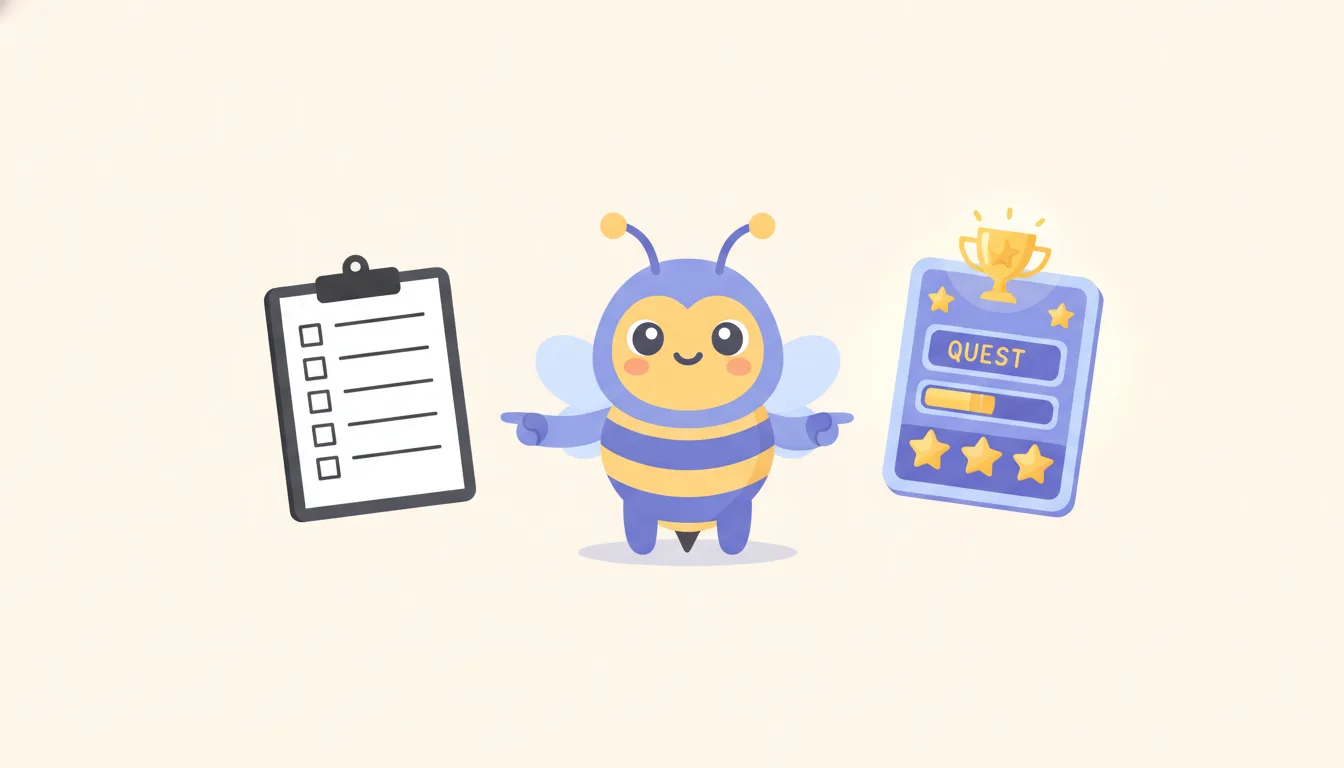
That’s the real difference in the BeeDone vs Todoist question. Todoist is the best task list ever made. BeeDone is a task manager built to get the task done. In this 2026 comparison, we’ll look at what each app genuinely does well, where they overlap, and — honestly — which one you should pick depending on what actually breaks down for you.
The Core Difference in One Paragraph
Todoist is a productivity tool for people who already have motivation. It assumes you know what to do and just need a reliable place to capture it, organize it, and check it off. Natural language input, labels, filters, projects — it’s an incredibly well-engineered list.
BeeDone is a productivity tool for people whose motivation is the bottleneck. It takes the same raw material — tasks, habits, routines — and wraps it in XP, levels, streaks, AI coaching, and focus tools so that starting and finishing feel rewarding instead of draining.
If your problem is organization, Todoist wins. If your problem is starting, BeeDone wins. Most people who switch aren’t switching because Todoist is broken — they’re switching because a list alone stopped working.
What Todoist Does Brilliantly
Let’s give Todoist its due. It didn’t get 30 million users by accident.
Todoist is the fastest capture tool in the business. Type “buy milk tomorrow 9am” and it understands the date, the time, and the task — no calendar, no forms, no friction. That natural language input is still the best in the category, and it’s the reason so many people never leave.
Its organizational system is genuinely powerful. Projects, sections, labels, filters, and saved views let you slice your life any way you want. Power users build incredibly refined systems with it, and Todoist gets out of the way while they work.
Integrations are unmatched. Todoist connects to Google Calendar, Slack, Zapier, IFTTT, and hundreds of other tools. If your workflow depends on automation, Todoist is the hub.
It’s fast and minimal. There’s no learning curve, no gamification to configure, no AI to talk to. Open, capture, organize, done. For people who just want a clean list, nothing beats it.
It works everywhere. Web, Windows, Mac, iOS, Android, plus widgets and quick-add from anywhere. Todoist is everywhere you are.
What Todoist Doesn’t Do (And Why It Matters)
Here’s the honest part. Todoist’s minimalism is also its ceiling.
Todoist gives you no reason to start. Check a task off and a small animation plays. That’s the entire reward system. The app is built on the assumption that motivation comes from somewhere else — from you, from your manager, from your deadline. When that external pressure is missing, the list just sits there. This isn’t a bug; it’s a design philosophy. But it’s exactly why so many people describe their Todoist as “a graveyard of tasks I never did.”
Todoist had gamification — and removed it. The company introduced a “Karma” system in 2013 that awarded points for completing tasks on time. It was retired in 2021 because, in Doist’s view, it pushed people to optimize for the score rather than the work. That’s a fair argument for some users. But for people with ADHD or low-motivation periods, the absence of any immediate feedback loop is a real loss. You’re left with a list and a vague promise that organization alone will fix things.
There’s no coaching, no routines, no focus system. Todoist manages tasks. It doesn’t help you break down a task you keep avoiding. It doesn’t help you build a habit. It doesn’t give you a timer for deep work. Every one of those needs another app, and each extra app is another place your system can fall apart.
The Feature Comparison
| Feature | BeeDone | Todoist |
|---|---|---|
| Task management | ✅ Full (quests, priorities, due dates) | ✅ Gold standard |
| Natural language capture | ⚠️ Good, not its superpower | ✅ Best in class |
| Gamification (XP, levels, streaks) | ✅ Core architecture | ❌ Karma removed (2021) |
| AI coaching | ✅ 8 coaches with distinct personalities | ❌ None |
| AI task splitting | ✅ Built-in | ❌ None |
| Habit tracking | ✅ Advanced, flexible frequency | ❌ No |
| Routines (morning, evening) | ✅ Built-in | ❌ No |
| Deep Work focus timer | ✅ Built-in | ❌ No |
| Mini-games / breaks | ✅ FlappyBee, BeeSnake | ❌ No |
| Integrations | ⚠️ Growing | ✅ Unmatched ecosystem |
| Team / collaboration | ❌ Solo-focused (link sharing only) | ✅ Projects, comments, assigned tasks |
| Free tier | ✅ Novice plan | ✅ Basic free plan |
| Premium | $8/mo Pro, $120 lifetime | Subscription (Pro) |
| ADHD-friendly design | ✅ Built around dopamine and friction reduction | ⚠️ Neutral — no motivation layer |
Where Todoist Wins (Be Honest)
If you’re a team of two or more sharing a project, pick Todoist. Its collaboration features — shared projects, comments, assigned tasks, activity logs — are mature and reliable. BeeDone is a personal productivity app; it shares tasks via links, but it’s not a team board.
If you live inside an automation stack, pick Todoist. The Zapier/IFTTT/API ecosystem is a decade ahead. BeeDone is building integrations but isn’t there yet.
If you want zero learning curve and a pure list, pick Todoist. Nothing about BeeDone’s gamification or coaching is required — you can use it as a simple task list — but if you’re allergic to any layer beyond “write it down,” Todoist’s restraint is the feature.
Where BeeDone Wins
When starting is the problem. This is the whole thesis. BeeDone turns every task into a quest with XP, levels, and streaks, so there’s an immediate, tangible reason to do the next thing. It doesn’t replace discipline; it makes discipline easier by making the reward loop instant. For ADHD brains, that immediate feedback isn’t a gimmick — it’s the difference between an app that gets used and one that gets abandoned on day four. (We dug into the psychology behind this in why gamified productivity works.)
When you need a coach, not a list. BeeDone’s 8 AI coaches notice patterns — “you’ve skipped your morning workout three days in a row, want to move it to evening?” — and adapt their tone to your state. Todoist has nothing like this. It tells you what’s on your list. BeeDone helps you actually approach it.
When one app should cover everything. Tasks, habits, routines, deep work, and mini-games in one place. Todoist handles tasks and leaves the rest to a stack of apps. BeeDone consolidates the stack, which removes the context-switching overhead that kills productivity systems.
When a task feels too big. The AI Task Splitter breaks an overwhelming project into concrete subtasks with visible endpoints — the single highest-leverage feature for people who avoid big tasks. Todoist’s subtasks are manual and flat. (See also: why big tasks feel impossible and how chunking fixes them.)
When forgiveness matters more than perfection. BeeDone’s streaks have recovery mechanics. Miss a day, and you don’t lose everything — the system encourages getting back on track instead of punishing you into quitting. Todoist has no streaks at all, but its all-or-nothing completion model gives you nothing to protect, and nothing to come back for.
Where BeeDone Fits
The honest verdict: choose Todoist if your system is already working and you just want it faster and cleaner. Choose BeeDone if the system itself keeps failing — if tasks sit, habits die, and motivation runs out.
BeeDone fits the person who has tried Todoist (or Things, or TickTick, or Notion), made beautiful lists, and still watched the important things slide. It fits the ADHD user who needs feedback loops designed for a dopamine-driven brain. It fits the solopreneur who needs tasks + habits + routines + focus in one app instead of four.
It is not a replacement for Todoist in a team context, and it doesn’t pretend to be. It’s a personal execution layer: XP and levels for tasks, habits, and routines; 8 AI coaches that adapt to your state; a Deep Work timer that gamifies focus sessions; an AI Task Splitter for the tasks you keep avoiding; and mini-games that contain your breaks instead of letting them swallow your day. If you’ve been meaning to try a gamified approach to productivity, this is where BeeDone enters the game.
The Verdict
Todoist is the better list. BeeDone is the better system for actually doing things.
- Pick Todoist if: you need team collaboration, deep integrations, or the fastest pure capture tool in existence — and your motivation is not the bottleneck.
- Pick BeeDone if: you have tasks that sit for weeks, habits that never stick, ADHD or low-motivation patterns, or you want one app for tasks + habits + routines + focus.
Looking at other market leaders? Read our head-to-heads with Habitica and our roundup of Habitica alternatives.
The two apps are not really competing for the same user. Todoist optimizes the moment you write a task down. BeeDone optimizes the moment you’re supposed to start it — and that’s where most productivity actually lives or dies.
Frequently Asked Questions
Is BeeDone better than Todoist?
It depends on your bottleneck. Todoist is better for organization, team collaboration, and integrations. BeeDone is better for motivation, habit building, and ADHD-friendly task management. If tasks sit undone on your list, BeeDone solves the problem Todoist can’t see.
Does Todoist have gamification?
Todoist had a gamified Karma system from 2013, but it was retired in 2021. Today Todoist has no XP, levels, or streaks. BeeDone is built entirely around gamification — tasks become quests that earn XP and level you up.
Is BeeDone good for ADHD?
Yes. BeeDone is designed around immediate feedback loops, forgiving streaks, task splitting, and AI coaching that adapts to your state — the mechanisms research shows ADHD brains respond to. Todoist’s neutral list design leaves motivation entirely to the user.
Can I use BeeDone as a simple task list?
Yes. You can ignore the gamification and coaching layers and use BeeDone for plain task management. But if you only want a minimal list, Todoist is simpler and faster at that one job.
Does BeeDone work for teams?
Not as a team project manager. BeeDone shares tasks via links (easy delegation), but it’s built for personal execution. Teams should use Todoist or a dedicated project management tool.
Is BeeDone free?
Yes. BeeDone has a free Novice plan, a Pro Player plan at $8/month, and a one-time Legend plan at $120 for lifetime access. No credit card is required to start.
BeeDone is available on iOS and Android. The app includes tasks, habits, routines, deep work, AI coaches, and built-in mini-games in a single gamified productivity system.