Why Your Productivity System Needs Gamification (And Not Just for Kids)
Why Your Productivity System Needs Gamification (And Not Just for Kids)
Mention gamification and most people picture a fitness app with badge rewards, or a language learning app with a cute mascot cheering you on. Something playful. Something for casual users who need their hand held.
Something not serious.
This assumption is costing you. Because gamification — done right — isn’t about making productivity “fun.” It’s about engineering the exact psychological conditions that make humans follow through on intentions. And those mechanisms are anything but childish.
The “I’m Too Serious for Gamification” Problem
There’s a persistent myth in productivity circles: if you’re relying on external motivators like points and badges, you’re not really committed. True high-performers don’t need rewards. They just do the work.
This myth is appealing because it flatters a certain self-image. But it collapses under scientific scrutiny.
Human motivation is not a personality trait. It’s a neurochemical state. And that state is heavily influenced by environmental design — including the design of the tools you use to manage your work.
Dopamine, the primary neurotransmitter of motivated behavior, is released in response to:
- Progress signals (you’re getting closer to something)
- Uncertainty and anticipation (you don’t know exactly what happens next)
- Social feedback (someone is watching, judging, celebrating)
- Loss aversion (something you have could be taken away)
None of these are “childish.” They’re the fundamental operating system of the human brain. Gamification is the discipline of designing environments that reliably trigger these states.
What Gamification Actually Does (Beyond Badges)
The term “gamification” has been diluted by a decade of shallow implementations — think loyalty cards or participation trophies. Real gamification, the kind that shows up in well-designed productivity apps, does something more precise:
It makes progress visible
The biggest killer of productivity is progress blindness — the sense that your work isn’t moving anything forward. This is especially insidious for long-term projects where weeks or months of effort produce no tangible output.
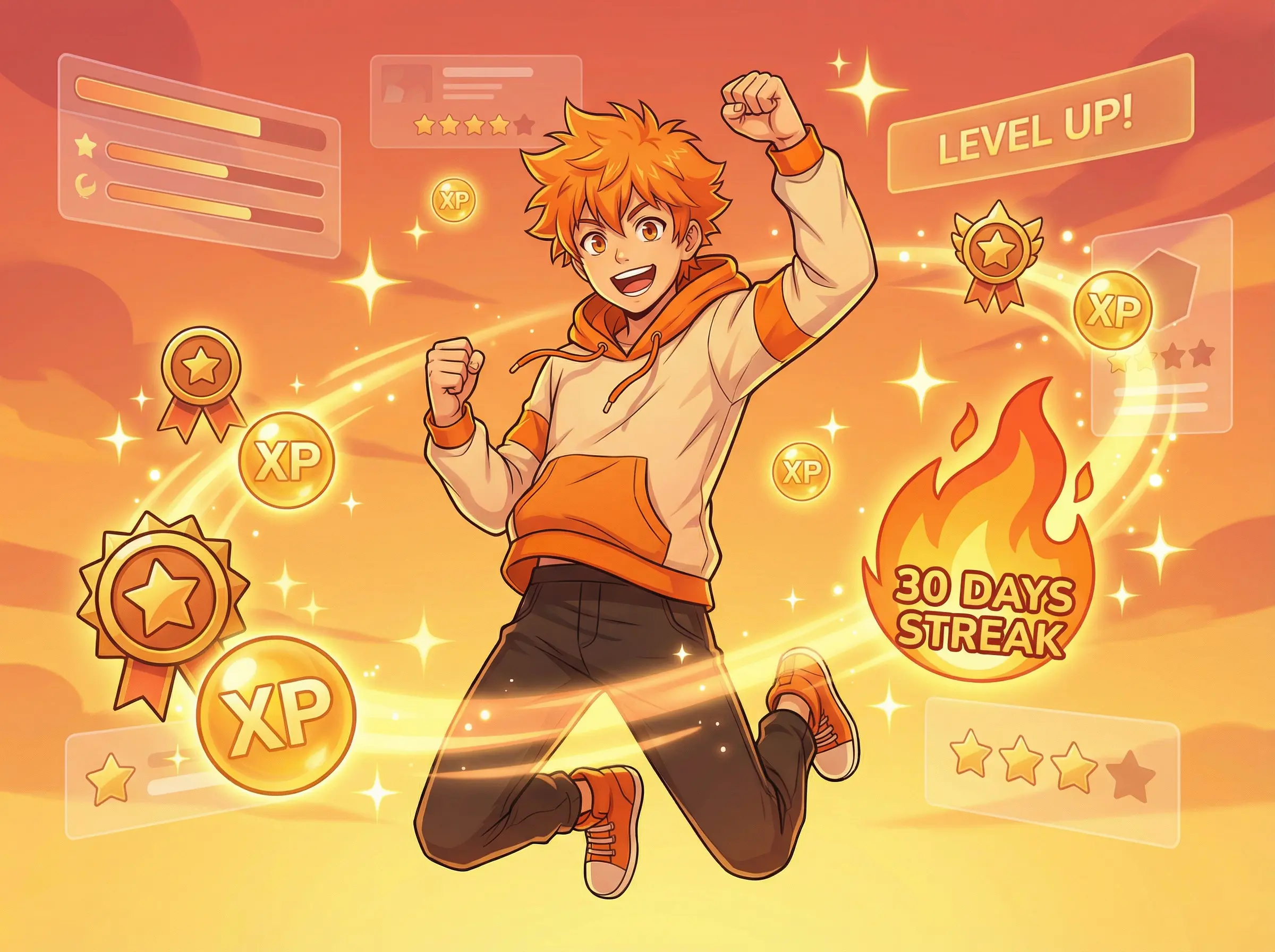
Gamification attacks this through visible progress indicators. XP bars. Level numbers. Streak counters. Completion percentages. These aren’t decorations — they’re data visualization for motivation. They show you that the system recognizes your effort, even when the external world doesn’t.
A 2021 study in the Journal of Medical Internet Research found that gamified health interventions significantly outperformed non-gamified versions in sustaining behavior change over 6 months. The mechanism: participants could see their progress, which maintained engagement when results hadn’t materialized yet.
It introduces healthy loss aversion
Most productivity advice focuses entirely on gains: what you’ll earn, achieve, become. But the prospect of losing something already earned is a much more powerful motivator for most people.
Streak mechanics are the clearest example. You’ve been training for 12 days. Your streak is 12. The thought of losing that streak and resetting to zero — even though it’s entirely arbitrary — creates a psychological cost to skipping a day that pure goal-setting never does.
This is why streak-free productivity apps have a fundamental motivation design problem. They rely entirely on future gains to drive present behavior. Gamified systems give you both gains and loss avoidance. Two motivational levers instead of one.
It structures the feedback loop
One of the most reliable findings in behavioral psychology is that variable-ratio reinforcement schedules — unpredictable rewards given after varying amounts of effort — produce the most persistent behavior. This is the same mechanism that makes slot machines addictive.
Gamified productivity apps, when well-designed, create something similar: you complete a task, you get XP (variable amount based on difficulty), you might level up (uncertain timing), you might unlock a new feature or badge. The reward isn’t the badge itself. It’s the uncertainty and the anticipation that keeps you coming back.
It creates social proof and identity
“X people have reached this level.” “You’re in the top 10% of users this week.” “Your streak is longer than 80% of the community.”
These signals do two things simultaneously. First, they provide social proof that the behavior is worth doing. Second, they start to construct an identity: you’re the kind of person who trains every day, who levels up, who maintains streaks.
Identity-based motivation is more durable than outcome-based motivation. When you see yourself as a “level 47 productivity athlete,” missing a day feels like a contradiction of who you are — not just a missed opportunity.
Why Most Gamification Fails
To be clear: most gamification is bad. Adding XP to a todo list doesn’t make it motivating. Fake badges for completing real work is patronizing. Leveling up for its own sake creates engagement theater without behavioral change.
The difference between good and bad gamification:
Bad gamification rewards activity, not progress. You get points for opening the app. You get badges for completing tasks you were going to complete anyway. The system trains you to optimize for the metric, not the outcome.
Good gamification aligns rewards with genuine effort. XP is proportional to difficulty. Streaks require real consistency. Levels reflect cumulative achievement that actually represents growth. The game mechanics are a reward layer on top of meaningful behavior, not a substitute for it.
Bad gamification is static. The same challenges, the same badges, the same leaderboard forever.
Good gamification adapts. AI-driven difficulty adjustment. Personalized challenges based on your patterns. New content and mechanics that keep the system feeling fresh without requiring you to relearn everything.
Bad gamification is isolated. The points don’t mean anything outside the app. The badges aren’t recognized anywhere.
Good gamification connects to real identity. Your progress is part of a community. Your consistency has social proof. The skills you build are real skills, not just app-internal achievements.
What to Look for in a Gamified Productivity App
If you’re evaluating whether a gamified productivity system is right for you — or if you’re looking to upgrade from a non-gamified system that’s clearly not working — here’s what actually matters:
The game mechanics should reinforce your actual goals. If you want to build a daily writing habit, you need daily writing XP, not points for completing any task. The gamification layer should make your specific objectives easier to pursue, not just add visual noise.
Loss aversion should be real but not crushing. A streak is motivating. A streak with a punitive reset mechanism that makes you want to quit entirely is counterproductive. Look for systems that encourage recovery over perfection.
The social layer should add accountability, not comparison anxiety. Leaderboards are motivating for some people and demoralizing for others. Look for apps that let you control social visibility and find accountability structures that match your temperament.
AI integration matters for sustained engagement. The hardest part of gamified productivity isn’t starting — it’s maintaining variety. Apps that use AI to generate personalized challenges, suggest new routines, and adapt difficulty keep the system fresh without requiring constant manual input.
The system should work for your brain type. This is often overlooked. People with ADHD, in particular, often find that non-gamified productivity systems fail because they rely on future reward mechanisms that ADHD brains don’t process well. Gamified systems that provide immediate feedback loops can work significantly better.
The Stigma Is Fading (And About Time)
There’s a generational shift happening in how people view productivity tools. The stoic, minimalist approach — white text on black background, no notifications, no celebration of small wins — used to carry an air of sophistication. Using something with XP and levels felt unsophisticated.
That stigma is dissolving for good reason. The data on gamified behavior change is too strong to ignore. And the apps have gotten dramatically better — moving from superficial badge systems to genuinely sophisticated motivation design.
The question isn’t whether gamification is appropriate for serious adults. The question is which implementation is sophisticated enough to produce real behavior change without feeling manipulative.
BeeDone was built around this exact insight. Eight AI coaches, dynamic difficulty, energy systems that prevent burnout, streak mechanics that encourage consistency without punishing imperfection. The gamification isn’t decoration. It’s the motivation architecture.
If you’ve tried productivity apps before and they didn’t stick, the problem might not have been you. It might have been the tool.
Frequently Asked Questions
Isn’t gamification just for kids and fitness apps?
No. The underlying mechanics — immediate reward, visible progress, streaks — map onto how adult motivation works too. Serious productivity systems use them because the psychology is age-independent.
Why does adding XP and levels to tasks actually work?
They convert delayed, abstract payoff into immediate, concrete feedback. Finishing a task becomes a visible win now, which reinforces the behavior far more reliably than the distant benefit of the task itself.
Can gamification work for someone who dislikes games?
Yes, because it isn’t about playing a game — it’s about getting immediate feedback on progress. Even people who never touch games respond to seeing a streak grow or a level advance.