BeeDone vs Forest: Яка програма фокусування дійсно працює для ADHD та глибокої роботи? (2026)
You open Forest, plant a virtual tree, set a 25-minute timer, and your phone locks you out of every app until the timer runs out. It’s simple, it works for some people, and somewhere in your digital forest a small tree is growing.
But then the timer ends. Your email is still there. Your Slack is still there. And the task you were supposed to finish — the proposal, the deck, the code review — is still sitting exactly where you left it, untouched. A nice tree doesn’t ship projects.
Or maybe the real problem isn’t the timer at all. Maybe the real problem is that you have no idea what you’re supposed to do next. The thing is too big, too abstract, too much of a mess to even start. Forest’s timer can’t help with that. It just counts down.
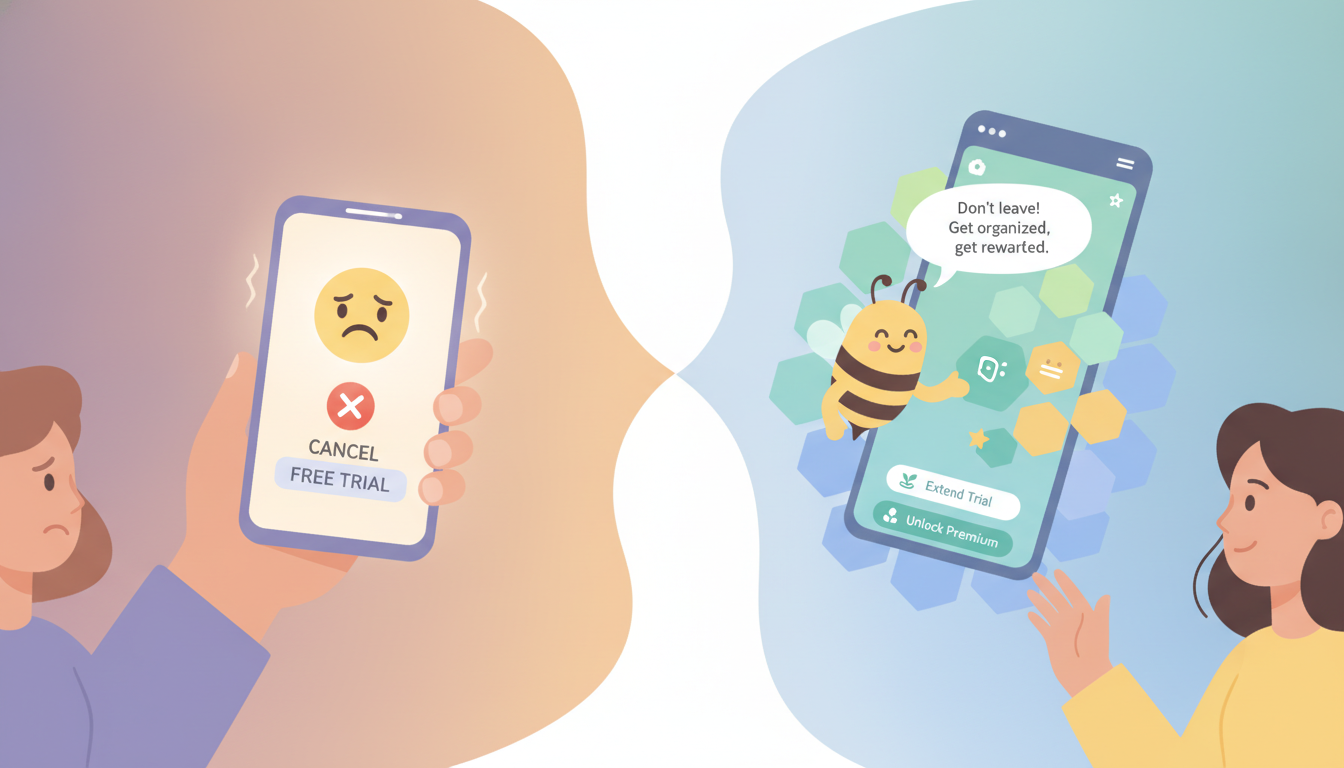
This is the BeeDone vs Forest question in 2026. Both apps promise focus. Both have millions of users. But they solve completely different problems — and picking the wrong one for your actual bottleneck is how focus apps end up deleted.
The Core Difference in One Paragraph
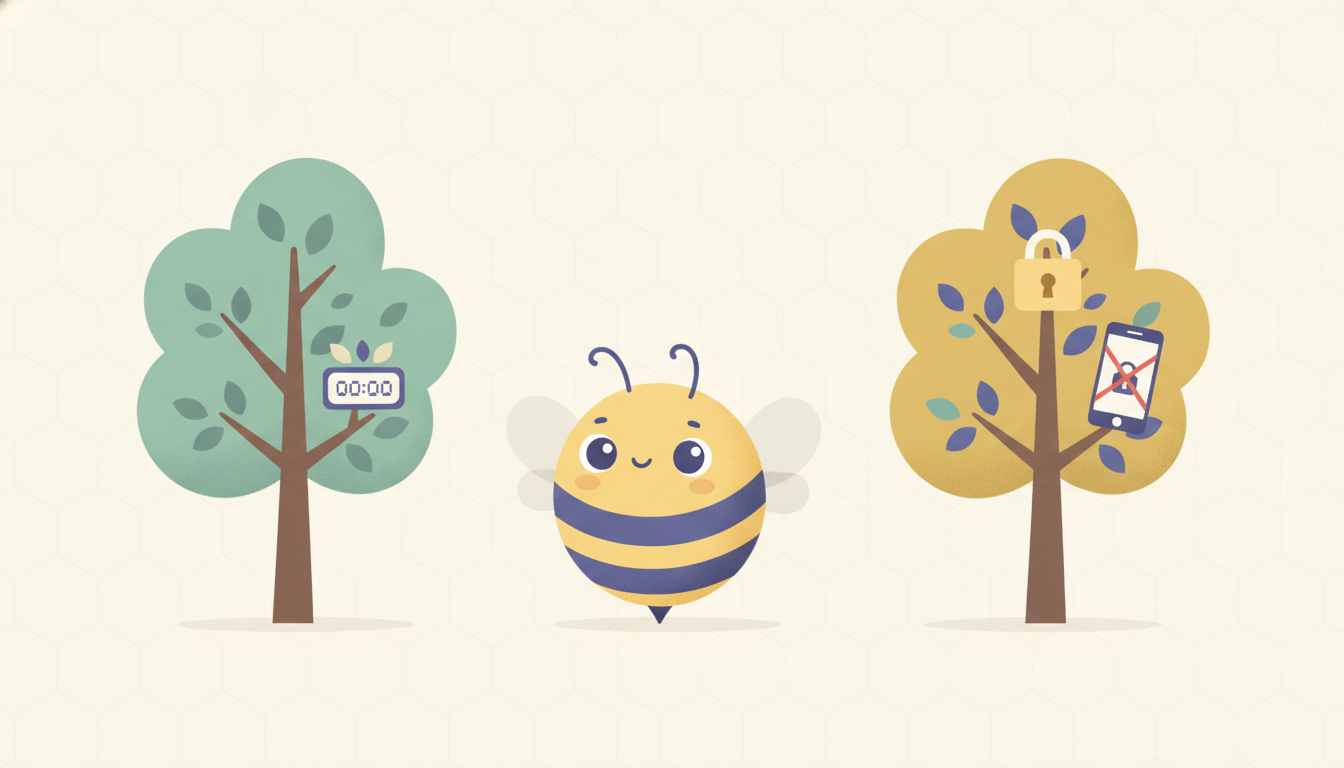
Forest is a focus timer with gamification layered on top. You plant a tree when you start a session, the tree grows while the timer runs, and if you leave the app before time’s up, the tree dies. The reward is the visual forest you build — a tangible representation that you’ve put in focus time. The core mechanic is simple: timer → stay focused → grow a tree.
BeeDone is a comprehensive ADHD-focused productivity system where Deep Work is one piece of a much larger engine. It combines task management, habit tracking, routines, AI coaching, and gamification with a lock-screen Deep Work mode that doesn’t just count down — it blocks your phone entirely and suggests what to work on next. The core mechanic is: what’s the actual work? Break it into pieces. Do a piece. Get XP. Repeat until it’s done.
Put simply: Forest helps you focus right now. BeeDone helps you finish the actual work — and it starts before you even open the timer.
What Forest Does Brilliantly
Forest didn’t earn millions of users and a 4.7-star rating on the App Store by accident. Let’s give the trees their due.
The focus timer actually works. Forest’s simplicity is intentional. You decide to focus, you open the app, you plant a tree, and there’s a psychologically real cost to abandoning it: the tree dies. For many people — ADHD, distracted, easily pulled into notifications — that friction is the single thing that keeps them on task. No complexity, no task list, just: timer running, tree growing, stay focused.
The visual forest is genuinely motivating. After a month, you’ve got a small garden. After a year, you’ve got a whole forest. That progress is visible, and for many people the pride of a full screen of trees is real motivation. It’s something to show for your focus time, and that’s not a trivial thing.
It’s radically simple. No account required for the free version, no learning curve, no overwhelming options. Open app, set timer, close app, tree grows. That simplicity is exactly why it works for so many people. When you’re already struggling with executive function, an app that doesn’t ask you to think is a gift.
It’s incredibly cheap. Forest’s business model is smart: free with ads, or a few dollars for the ad-free version. You don’t have to commit to a subscription. Many people run Forest for years on a one-time $4.99 payment.
What Forest Doesn’t Do (And Why It Matters)
Forest is brilliant at what it does. It is not brilliant at everything — and here’s where the gaps appear, especially if you have ADHD.
Forest has no task management. You can add a title to your session (“work on report”), but there’s no actual task system. No priorities, no due dates, no projects, no way to see what you’re supposed to do when the timer ends. You know you need to focus for 25 minutes; you do not know what you’re focusing on or whether it matters.
There’s no task-splitting or breakdown. If an project feels overwhelming — “build the feature,” “rewrite the docs,” “fix the bug” — Forest can’t help you turn that into concrete steps. The tree keeps growing. The paralysis remains exactly as tall as it was before. For ADHD brains that live in “everything is one giant amorphous blob,” this is a real limitation.
There’s no routing to what matters next. Your timer just ended. You did 25 minutes of focus. What now? You have to decide. You have to scan your brain or your email or your project board to figure out what the next 25-minute session should tackle. That context-switching, that “what do I do now,” is executive-function friction. Forest adds nothing to that moment.
There’s no habit or routine system. You can set multiple timers in a day, but there’s no mechanism for building sustainable focus routines (morning deep work, post-lunch focus, evening wind-down). You’re planning each session independently.
There’s no coaching or adaptive intelligence. Forest doesn’t watch your patterns. It doesn’t notice that you’ve been avoiding a specific task for three weeks and suggest you break it down differently. It doesn’t know that mornings are your best focus window and suggest you schedule important work then. It’s a timer, not a system.
Big tasks stay big. If you’re looking at “write the book chapter” or “audit the codebase,” 25 minutes on Forest won’t teach you how to make progress on it. A timer alone doesn’t unlock momentum.
The Feature Comparison
| Feature | Forest | BeeDone |
|---|---|---|
| Focus timer | ✅ Best in class (Pomodoro, visual growth) | ✅ Built-in with Deep Work mode |
| Task management | ❌ None | ✅ Full (quests, priorities, due dates, smart sorting) |
| Habit tracking | ❌ None | ✅ Advanced, flexible frequency |
| Structured routines (morning, evening, etc.) | ❌ None | ✅ Built-in routine chains |
| AI coaching | ❌ None | ✅ 8 coaches with distinct personalities |
| AI task splitting | ❌ None | ✅ Built-in (“break this into steps”) |
| Lock-screen blocking on Deep Work | ❌ Timer only, apps accessible | ✅ Full lock-screen block + routing to next task |
| Gamification of task completion (XP, levels) | ⚠️ Tree-building only | ✅ Core architecture (XP for every task) |
| Streaks with recovery mechanics | ❌ No streaks | ✅ Built-in, forgiving (recover in 2 hours) |
| Mini-games for break time | ❌ None | ✅ FlappyBee, BeeSnake, more |
| Platforms | iOS, Android | iOS, Android, Web |
| Free tier | ✅ Free with ads, or $4.99 one-time | ✅ Novice plan, no credit card |
| Premium | One-time $4.99 (usually) | $8/mo Pro Player, $120 lifetime Legend |
The Two Philosophies: Timer vs. System
Here’s what’s really happening philosophically.
Forest’s philosophy: “Humans struggle with focus because we’re distracted. Give them a reason to stay on task (the tree), remove temptation (the timer), and focus time will accumulate. The forest you build is proof you did the work.”
BeeDone’s philosophy: “Humans with ADHD (and many without) struggle with focus because they don’t know what to do next, the thing is too big to start, and there’s no immediate reward for effort. Give them real task management, break big things into small pieces, lock their phone so nothing pulls them away, and coach them on what matters. The XP, levels, and streaks arrive as you work, not after you’ve already struggled through it.”
One is about removing distraction. The other is about making progress visible and immediate.
When Forest Wins
If your problem is pure distraction. You know what you need to do. You’re a focused person when your phone doesn’t interrupt you. Forest solves that with ruthless simplicity. The 25-minute timer where you can’t even see your apps is remarkably powerful for people whose issue is “I open Twitter and three hours vanish.”
If you want a reason to open an app every day. The forest grows even if you plant one tree. There’s a daily ritual to it — a minimal one, but real. Many people who use Forest report that the forest-building habit keeps them coming back.
If you want to keep it simple. Some people want a focus app that’s just a focus app. No task list, no coaching, no motivational bells and whistles. Just: can you focus for 25 minutes? Forest does that.
If you need to minimize cost. $4.99 one-time is genuinely cheap. If you’re on a tight budget, Forest is a solid ROI.
When BeeDone Wins
When you don’t know what to work on. This is the classic ADHD moment: “I have work to do” (true) “but I don’t know where to start” (also true). BeeDone’s AI Task Splitter takes “write the proposal” and turns it into “write the executive summary, find three examples, draft the conclusion.” Suddenly you can start the first piece instead of staring at the amorphous blob. (Here’s the science.
When you need actual task management. You have 47 things to do. Some are due Friday, some are due next month, some are blocked by someone else. Forest has no way to express any of that. BeeDone lets you prioritize, set due dates, use smart sorting, and even shuffle tasks randomly when you’re in “I’ll do literally anything, just decide for me” mode.
When big tasks are the wall. 25 minutes on Forest doesn’t teach you how to break down a complex project into step one. BeeDone does.
When you need more than just a timer. Your best focus happens in the morning, but you keep scheduling deep work at 4pm because you didn’t plan it. BeeDone’s routine system lets you build a morning deep work habit that recurs automatically. The timer is smart enough to know when it should suggest focus time.
When focus isn’t the only problem. You might also struggle with habit consistency (“I keep skipping my morning exercise”), or you need a structured evening wind-down, or you want coaching that adapts to your patterns. Forest’s timer can’t touch any of that. BeeDone’s system is built for it.
When you need immediate motivation. Forest’s tree grows quietly over 25 minutes. BeeDone’s XP arrives during the work. You finish a task, you see the points, you level up, you feel the dopamine right away. For ADHD brains in particular, that immediate feedback is neurochemical medicine — it works. (More on why gamification works for ADHD.)
When focus is just one part of your system. You need habits, tasks, routines, and focus all connected. Forest is a standalone timer. BeeDone is one system where everything talks to everything else — your task appears in your routine, the routine chains habits together, Deep Work fits into your day, and XP ties it all together.
Where BeeDone Fits
The honest verdict: choose Forest if your single bottleneck is “I get distracted when I should be focusing.” Choose BeeDone if you struggle with the bigger problems: what to work on, how to break it down, staying consistent with habits, and turning effort into momentum.
BeeDone fits the person who has tried Forest, loved the timer, but watched their actual to-do list collect dust. It fits anyone with ADHD who knows they need structure to stay consistent, not just a timer for individual focus sessions. It fits the person who wants one system — tasks, habits, routines, deep work, coaching — instead of Forest plus Todoist plus a habit tracker plus a therapist.
The trade-off, stated plainly: BeeDone is more complex than Forest. It asks you to set up tasks and habits and routines. It costs more ($8/mo or $120 lifetime vs. Forest’s $4.99). And it won’t give you a beautiful forest to admire — the Novice plan is free, but Pro Player is where the full system lives. If you just want a simple, cheap focus timer and nothing else, Forest is the answer.
Many power users actually do both: Forest for the timer moment when they need deep focus on a specific sprint, and BeeDone for the overall system — tasks, habits, routines, coaching, that orchestrates their whole day. The free Novice plan makes that experiment cost nothing.
If you’re comparing other options too, we’ve done the same honest exercise with Finch, Todoist, and Habitica.
The real difference is this: Forest helps you focus for 25 minutes. BeeDone helps you actually finish the thing you’ve been avoiding for three weeks.
FAQ
Is Forest better than BeeDone?
For pure focus timers, Forest is exceptional — simple, effective, and beautifully designed. For comprehensive productivity and ADHD support, BeeDone wins with task management, AI coaching, routine building, and task splitting. The right choice depends on whether you need a timer or a system.
Does Forest have task management?
No. Forest is a focus timer with tree-building gamification. It has no way to add tasks, set priorities, or manage projects. You can add a label like “work on report,” but there’s no actual task system. BeeDone includes full task management, smart sorting, and task prioritization.
Can Forest help with ADHD?
Forest helps with one ADHD problem: staying focused during a task session. It doesn’t address the bigger ADHD bottlenecks: knowing what to do next, breaking down big projects, building consistent routines, or maintaining habits. BeeDone addresses all of those with AI task splitting, routine chaining, habit flexibility, and adaptive coaching.
Does BeeDone have a focus timer like Forest?
Yes. BeeDone’s Deep Work mode includes a focus timer, but it goes further: it lock-screens your phone entirely (not just the timer), and after the session ends, the app suggests what to work on next based on your tasks and priorities. It’s integrated into the larger system rather than standalone.
How much does Forest cost?
Forest is free with ads, or $4.99 as a one-time purchase for the ad-free version. That’s it — no subscription. It’s one of the cheapest focus apps available.
Is BeeDone free?
Yes. BeeDone has a free Novice plan with all core features (tasks, habits, routines), a Pro Player plan at $8/month, and a one-time Legend plan at $120 for lifetime access. No credit card is required to start.
BeeDone is available on iOS, Android, and Web. The app includes tasks, habits, routines, deep work, AI coaches, and built-in mini-games in a single gamified productivity system.