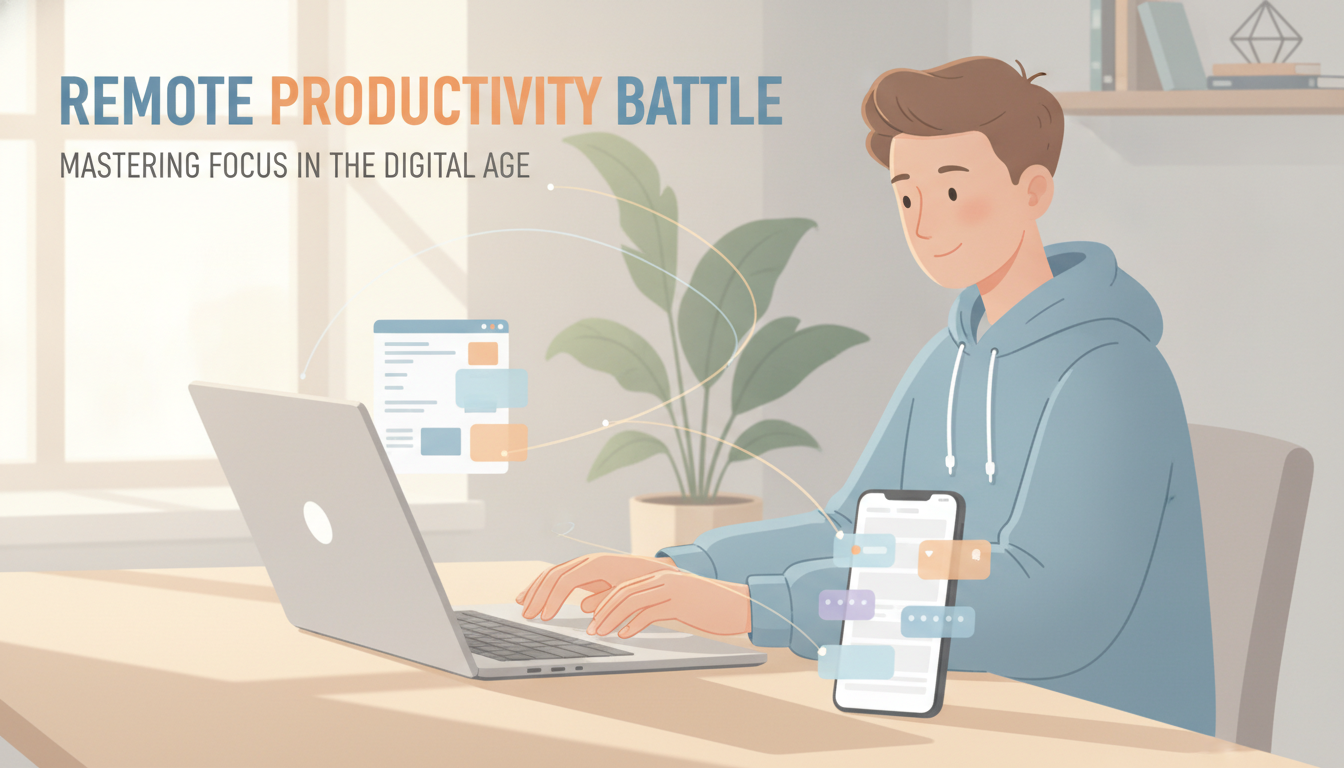
Remote Work Productivity: How to Actually Get Things Done Without Office Supervision
Remote work promised freedom. For many, it delivered isolation, meetings that should have been messages, and a guilt-driven workday with no clear start or end.
The data backs the feeling. Studies across distributed teams consistently find that the average remote worker spends less than half of their day in deep, focused work. The rest gets eaten by notifications, unscheduled check-ins, hallway Zoom calls, and the constant mental load of managing visibility without an office presence.
The shift from “supervised time” to “output accountability” exposes a gap: most remote productivity advice was written for people who are already good at self-regulation. If you’re not, remote work is not liberating. It is relentless.
Why Remote Work Drags Productivity Down
Context switching is the silent killer. Stanford research on remote software teams found that task switching and unscheduled interruptions reduced productive output by up to 40 percent. Each interruption costs around 23 minutes of recovery time. In an office, that interruption often has a cost to the interrupter too. Remotely, it scales into endless chat threads with no friction.
The visibility tax. When nobody can see you work, displaying productivity becomes a job in itself. Responding fast, posting updates, and over-attending optional meetings become proxies for effort. That is not work. That is emotional labor with no ROI.
Meetings replace async work. Face time pressure shifts to video presence pressure. Teams schedule more meetings to “stay aligned,” which destroys calendar blocks. The result: no time to do the work the meetings are supposed to advance.
Home friction. Shared spaces, family needs, appliances, and snacks are real distractors. In an office, you folded that into commute time. At home, it is always on.
The Remote Productivity System That Actually Works
1. Time blocking with task decomposition
Remote days need structure even if you hate structure. Plan the day before in 60-to-90-minute focus blocks. Decompose each block into a single deliverable, not a vague project title. Deliverables create finish lines.
2. Async-first communication
Default to messages over meetings. Reserve meetings for decisions that require real-time debate or sensitive feedback. Async reduces interruption rate and lets people work during their own energy peaks.
3. One meeting window
If you must meet, stack meetings into a single afternoon window. Mornings should be protected for deep work. Afternoon meeting blocks reduce switch tax and preserve the cognitive premium of early hours.
4. Output contracts, not activity surveillance
Replace status checks with defined outputs: what will be completed, in what state, by when. Output contracts respect autonomy and make accountability fair.
5. AI task triage and recalibration
AI tools are particularly useful for remote workers because they compress the planning loop. Smart task managers can suggest priorities, detect when your day is overcommitted, and protect focus blocks by blocking distractions.
The Patterns High-Performing Remote Teams Share
Fixed rituals with async supplements. Standups can be async without losing alignment. Synchronous time should be reserved for collaboration, conflict resolution, and decision-making, not status reporting.
Documented defaults, not assumed norms. Remote teams need written rules for response times, holidays, modes of communication, and handoff protocols. Ambiguity becomes a productivity sink when you cannot lean on body language or timing.
Energy-aware scheduling. Some people are deep-work people at 6 AM. Others peak after 4 PM. Remote work opens the possibility of personalized schedules. Most teams still force morning calendars. That mismatch is expensive.
Visible output, invisible labor. Good remote systems make work product visible: docs, demos, ship notes. When output is the signal, visibility theater dies.
What Not to Do
- Do not compensate for not being seen by overworking. That is burnout dressed as reliability.
- Do not overuse quick calls. If a question needs a meeting, it usually needs a document.
- Do not assume discipline solves the problem. Discipline is finite. Systems are repeatable.
The Tools That Help Without Adding More Noise
Effective remote productivity tools share a few traits: they reduce planning overhead, protect focus, and make priorities obvious without constant reappraisal.
AI coaching inside task managers can push back when you overcommit. Focus timers with Streak protection create the conditions for sustained effort. Gamification bridges the accountability gap that office social pressure used to fill.
The Bottom Line
Remote work’s biggest lie is that it gives you more time. It does not. It gives you more responsibility for how you use time. The workers who thrive are not the most disciplined. They are the ones who build systems that make good choices easier than bad ones.
If your current system depends on self-control, redesign it. Output targets, async rules, protected focus windows, and AI-assisted prioritization are not productivity hacks. They are infrastructure for a work style with no office walls.
Where BeeDone Fits
Everything above — output targets, protected focus windows, AI-assisted prioritization — is infrastructure you have to build and then actually run every day with nobody watching. That second part is where remote workers fail, and it is exactly the gap BeeDone was designed for.
BeeDone replaces office social pressure with game mechanics: streaks that make showing up feel like progress, deep work sessions that wall off your focus windows, and an AI coach that pushes back when your day is overcommitted before you burn it discovering that yourself. Tasks, habits, and routines live in one system, so “what should I do right now” stops being a decision you make forty times a day.
You don’t need supervision. You need a system that makes the good choice the easy one.
BeeDone is available on iOS and Android. The app includes tasks, habits, routines, deep work, AI coaches, and built-in mini-games in a single gamified productivity system.
Frequently Asked Questions
Why is it harder to stay productive working remotely?
Remote work removes the ambient accountability of an office and adds distraction, context switching, and a workday with no clear start or end. Most people lose two or more hours a day to it without noticing.
What actually works for remote productivity?
Systems, not self-control: output targets instead of hours, protected focus windows, async rules that cut meetings, and AI-assisted prioritization so you aren’t re-deciding what matters all day.
How does BeeDone help remote workers?
It replaces office social pressure with game mechanics — streaks that reward showing up, deep work sessions that wall off focus time, and an AI coach that pushes back when you overcommit.